Want to attend the course but can’t make it on this date?
Fill in your details below and we’ll notify you when we next present a course in this area:
 Snakebite case history
John Nesbitt had been looking forward to his African Safari and had been saving up for a few years for the adventure. After extensive research, he settled on a luxury lodge on the western edge of the Kruger National Park. The lodge has phenomenal Google reviews, and most guests saw the Big Five within a day or two. Despite John paying with British pounds, it was still a very expensive holiday.
The flight to OR Tambo International Airport was pleasant and roughly in the same time zone – no jet lag and an upgrade to business class using air miles made the flight incredibly comfortable. The short flight to the Hoedspruit Airport was bumpy, and then a long drive through the Kruger National Park to the lodge. It was a magnificent drive with lush bush and no shortage of wildlife – several elephants, a Spotted Hyena with cubs and a pride of lions quite far from the road with a little more than their ears visible. Quite a start to a trip of a lifetime.
It was late afternoon by the time they got to the lodge, and after unpacking and a quick shower, it was dinnertime. A five-course meal under the stars with Spier 21 Gables Cabernet Sauvignon and a Springbok shank. The sound of nightjars and a jackal calling in the distance sealed off a good day. It was going to be an early night as the game drive would depart at 06:00 the following morning.
Close to midnight, John suddenly felt a burning pain in his right shoulder and leapt out of bed and switched the lights on. He was disorientated and confused and saw some blood on the sheets. He instantly saw the coils of a large brown snake under his bed and realised that he had been bitten! Total panic set in as he had never seen a wild snake and was terrified.
He called reception in a panic, watching the snake from a few meters away and hysterically said that he had a snake in his room.
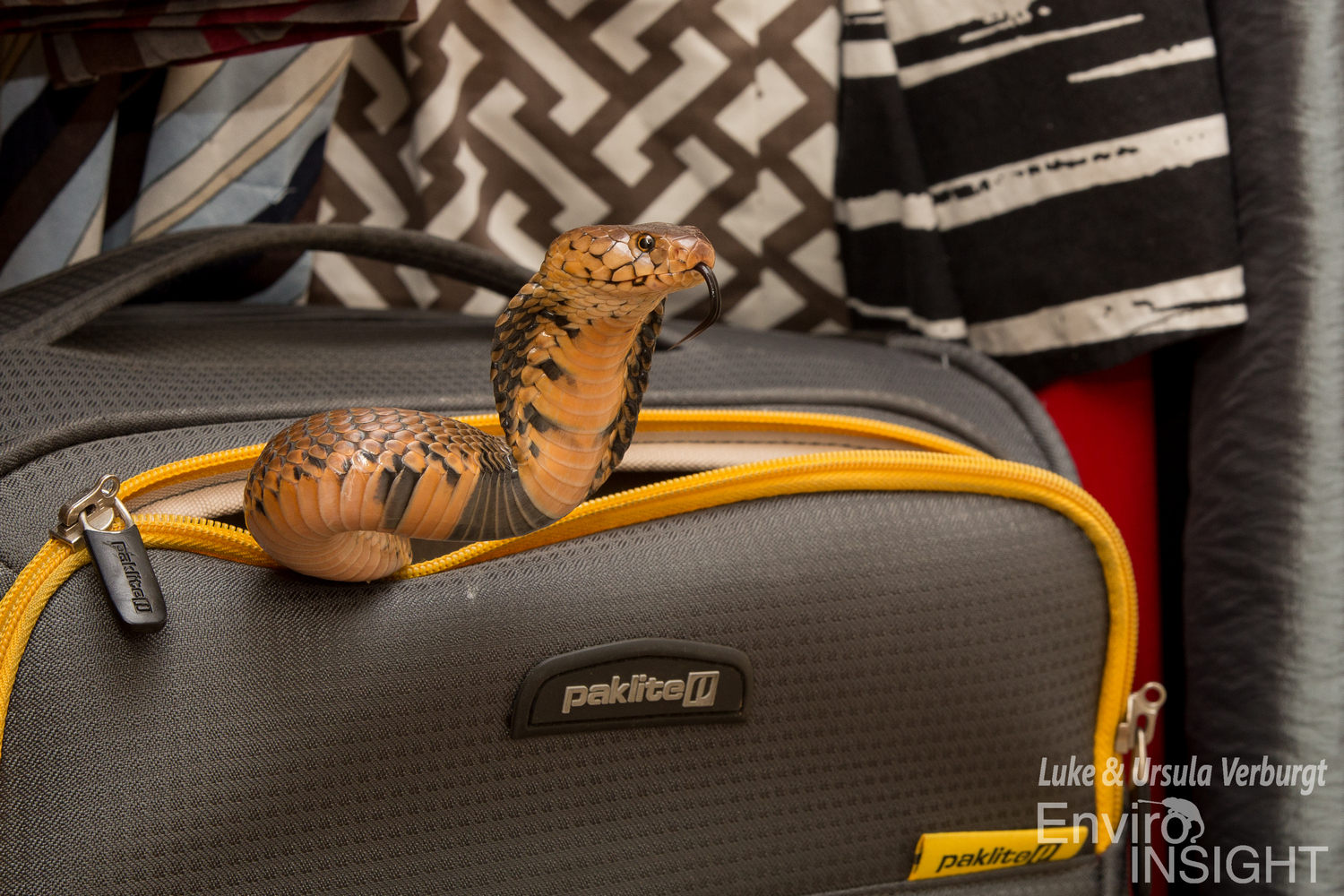
Fortunately for John, the lodge staff had all been trained in snake awareness, first aid for snakebite and venomous snake removal. The head safari guide got to his room within minutes, fully equipped with snake tongs, a snake bucket, safety glasses and a torch. The snake, a 1,2 m Mozambique Spitting Cobra, was quickly captured and secured.
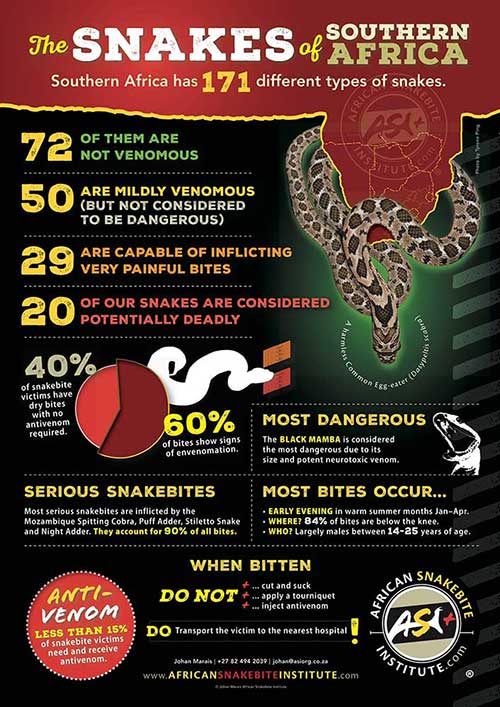
The lodge manager had already been alerted and had notified the private paramedic company that they had contracted to send an ambulance. This took close to half an hour, rather fortunate as they had an ambulance stationed within the park. The snake was positively identified as a Mozambique Spitting Cobra. The venom of this snake is predominantly cytotoxic, causing pain, swelling, discolouration and, in many cases, tissue damage. There is little that one can do from a first aid point of view, and tight bandages, especially arterial tourniquets, must be avoided at all costs.
John was completely stressed out and in pain, and was reassured by the lodge staff that he was going to be fine. As he had good medical insurance, it was decided to transport him to a private hospital in Nelspruit. This took more than two hours as they had to travel through part of the Kruger National Park at night and at low speed because of animals.
Upon arrival at the hospital, the medical team was ready for John and had ample stock of SAVP polyvalent antivenom. This antivenom covers the venom of ten snake species, including the Mozambique Spitting Cobra. When it comes to treating serious snakebites, SAVP polyvalent antivenom is often lifesaving, provided it is administered early enough and in sufficient quantity. A major concern with Mozambique Spitting Cobra bites is that it is generally believed that if the antivenom is not administered within two or three hours, it does little to reduce tissue damage and is often not given.
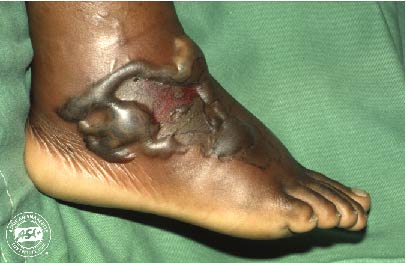
More research into the effectiveness of antivenoms is desperately needed, as we do not have good data to confirm how effective various antivenoms are on all bites, but especially the bite of the Mozambique Spitting Cobra. The doctors, in this instance, proceeded to administer 12 vials of polyvalent antivenom. They were well prepared for anaphylaxis, which presents in up to four out of ten snakebite victims. After pre-medicating the patient with 0,25 mg of Adrenaline, the antivenom was infused via a saline drip over a period of thirty minutes. John was fortunate – he did not have an allergic reaction to the antivenom. As per the published snakebite protocols, no anti-inflammatories or antibiotics were administered, and pain was managed with intravenous Paracetamol.
By sunrise, the swelling had progressed down the arm and into the chest region, with dark patches on the chest, referred to as skipped lesions. This is common in Mozambique Spitting Cobra bites. The swelling had stabilised, and no further antivenom was administered. Now it was a waiting game, and over the next few days, the treating doctors were able to assess the extent of tissue damage. This was of great concern but not life-threatening.
The dark necrotic patches spread over the next four days, but the medical team held off debridement until day 7, by which time the patches of necrosis were well defined. It is very important to hold off on surgical procedures until the full extent of necrosis is visible.
John was transferred to a hospital in Johannesburg, where he underwent another three sessions of surgery, which included skin grafts. He managed to fly back home five weeks later and had a good recovery.
Looking back at this incident, it ended up well. The lodge staff followed the correct procedures, the medical doctors were excellent in their approach to the bite, and even though the antivenom rarely prevents necrosis, it may well have neutralised enough venom not to affect other vital organs.
The Mozambique Spitting Cobra is well known for accidentally entering houses and lodges at night while hunting and locating people in their beds. The snake smells a mammal and bites in a feeding response, mistaking a human for a meal. This happens very often, and many people, including babies, end up with bites to the face, chest, arms or elsewhere. Such incidents can be avoided by installing mosquito doors on all exits, sealing gaps under doors and sleeping under mosquito nets that are tucked in under the mattress.
Other than spoiling a dream holiday for John, this incident cost his insurance company more than R1,5 million.
 ASI Book Combo 1
Original price was: R1,315.00.R1,120.00Current price is: R1,120.00.
ASI Book Combo 1
Original price was: R1,315.00.R1,120.00Current price is: R1,120.00.
 A Complete Guide to the Snakes of Southern Africa - 2022 Edition
R550.00
A Complete Guide to the Snakes of Southern Africa - 2022 Edition
R550.00
 Rangers Book Combo 2
Original price was: R2,080.00.R1,870.00Current price is: R1,870.00.
Rangers Book Combo 2
Original price was: R2,080.00.R1,870.00Current price is: R1,870.00.